

Discovery Place Science With Kids: Our Honest Review
Discovery Place Science was the biggest winner of our short Charlotte trip.
My almost-5-year-old son and I visited during the final day of a mother-son birthday trip through the Carolinas. We only had about 24 hours in Charlotte, so I had to be selective about what we tried to fit into our time.
Discovery Place Science was absolutely worth making room for.
It had enough animals and fish to immediately interest my son, enough hands-on exhibits to keep him moving, and enough creative spaces that we could follow his attention instead of forcing our way through a museum he was not ready to understand.
We spent a few hours there and easily could have stayed longer.
This guide covers what my son enjoyed, the best ages for Discovery Place Science, how much time to allow, parking, strollers, tickets, IMAX, and the other details that help parents decide whether it belongs in their Charlotte itinerary.
One quick clarification before we get into it: this post is about Discovery Place Science in Uptown Charlotte. It is not the same museum as Discovery Place Kids in Huntersville.
Is Discovery Place Science Worth Visiting With Kids?
Yes. Discovery Place Science was one of the best things we did during our entire trip through the Carolinas.
It worked especially well for my almost-5-year-old because the museum did not require him to stand still, read long exhibit signs, or understand complicated scientific concepts before he could participate.
He could watch fish, explore the animal exhibits, experiment with the hands-on activities, and create something of his own.
There were certainly scientific ideas he was too young to fully understand, but that did not stop him from enjoying the museum.
For our family, the appeal came from the combination of:
- hands-on science and building exhibits
- animals and aquarium displays
- enough variety to follow a young child’s attention
Discovery Place Science is currently described by the museum as a hands-on science museum with interactive exhibits, animal encounters, live experiments, and an IMAX Dome Theatre.
Best for: Preschool and elementary-age kids
Plan for: At least a few hours
Location: Uptown Charlotte
Our experience: Personally visited with an almost-5-year-old
Biggest highlights for us: The aquarium and Boxopolis
Main thing to know: Temporary exhibits change, so your visit may look different from ours
If you only have time for one kid-focused attraction in Uptown Charlotte, this would probably be my pick.
Traveling with kids?
Get the Free Travel Documents Checklist for Families
Before you head to the airport, make sure you’ve thought through the documents your family may need, including IDs, passports, birth certificates, consent letters, health documents, and helpful backup copies.

Our Experience at Discovery Place Science
Discovery Place Science was one of several Uptown attractions we visited during a very full final day in Charlotte.
We began the morning with breakfast at Charlotte Marriott City Center, walked back to the Fourth Ward Park playground, visited the NASCAR Hall of Fame, and then started walking toward Discovery Place Science.
We did not get there quite as quickly as expected.
My son spotted the LYNX Blue Line trains crossing the road in front of us and wanted to watch them, so we stopped at a station and sat for a while as the trains came and went.
Eventually, we continued walking to the museum.
By that point, we had already done a playground, a museum, a long walk, and an unplanned train-watching break. I would have understood if my son had started losing steam.
Instead, Discovery Place Science completely pulled him back in.
It had enough variety that we could move at his pace. When he was interested in an area, we stayed. When something did not immediately connect with him, we moved on without feeling as though we had missed the whole point of the museum.
That is part of what made the experience work so well.
Some museums feel as though there is one correct route or one way to appreciate what you are seeing. Discovery Place Science felt much easier to explore with a young child.
My son could be drawn in by a fish tank, move on to something he could touch, and then spend a long stretch of time building in a temporary exhibit.
I never felt like we were simply trying to fill time before our flight.
It felt like a full and worthwhile part of our Charlotte trip.
Best Discovery Place Science Exhibits for Kids
The exact mix of exhibits and programs can change, so I would check the current museum schedule before your visit.
These were the parts that stood out most during our visit:
World Alive: The Aquarium and Indoor Rainforest
The aquarium was the first thing my son noticed when we entered Discovery Place Science.
He absolutely loves animals and fish, and the large tank was hard to miss. So before we looked at anything else, that was where we went.
What made me laugh was that we had visited the South Carolina Aquarium in Charleston only a day earlier. Apparently, he had not come close to reaching his limit on sea life. He was still just as excited to stop and watch the fish.


From my perspective, the aquarium area is really cool, but I would not arrive expecting the size or depth of a dedicated aquarium. It is one part of World Alive, a larger exhibit that also includes the museum’s indoor rainforest.
That is where we headed next.
The rainforest felt much more like stepping into a small jungle, with plants, walkways, birds, and other animals hidden throughout the space. The museum had animal-spotting books available, and my son loved using the book to look for the animals pictured inside.
That gave him a reason to slow down and really study the exhibit instead of quickly walking through it. Each time he spotted something from the book, it felt like his own little discovery.
World Alive is designed to introduce visitors to different ecosystems through the aquarium and rainforest habitats. The rainforest includes birds, reptiles, and insects, although the exact animals families see may vary.
For younger children, I think this area works especially well because they do not need to understand a complicated scientific concept before they can participate. They can watch the fish, listen for birds, search for animals, and let that curiosity lead them into the rest of the museum.
Here’s a quick look at the indoor rainforest and the jellyfish in World Alive. They were completely different experiences, but both gave my animal-loving kid plenty to stop and watch.
Boxopolis
The biggest highlight of our visit was a temporary exhibit called Boxopolis.
The museum had dedicated an entire room to building a city out of reused cardboard boxes. Visitors could create their own contribution and add it to the larger city.
It was a simple concept, but it was such a good one.
My son could look at everything other people had created, decide what he wanted to add, and become part of the exhibit instead of only walking through it.


He loved every minute of it, and there was something especially sweet about watching him turn cardboard boxes into part of a shared city after we had spent several days traveling through real cities together.
Temporary exhibits are one reason I would check the Discovery Place Science website shortly before your trip. Boxopolis was the standout for us, but your family may find a completely different rotating experience during your visit.
Hands-On Science, Building, and Creative Exhibits
The hands-on exhibits were a huge part of why Discovery Place Science worked so well for my son.
At almost 5, he was not going to spend the afternoon carefully reading every sign or trying to understand the full scientific explanation behind each activity. He wanted to build something, move the pieces around, see what happened, and then move on when he was ready.
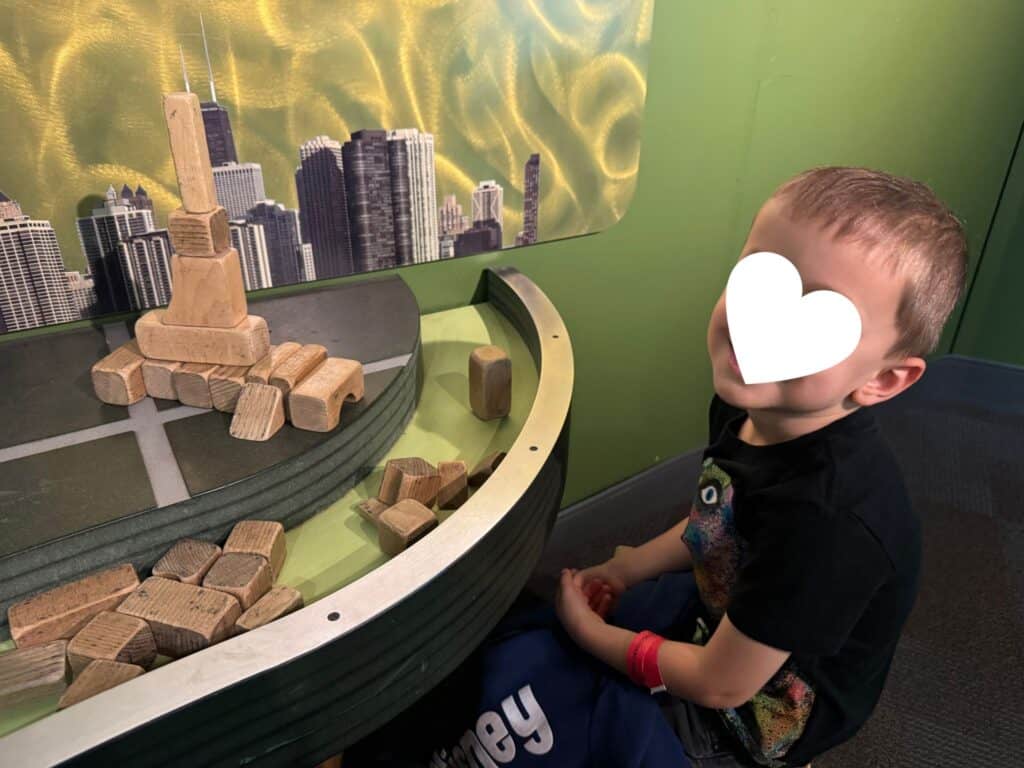
In Project Build, he used wooden blocks to recreate the city skyscrapers pictured behind the table. He studied the shapes, stacked the pieces, knocked parts down, and tried again until his version looked the way he wanted it to.

He also spent time building a giant carbon nanotube. The large pieces represented carbon atoms, and the goal was to connect them into a tall structure while looking for the repeating honeycomb pattern.


He obviously was not walking away with a complete understanding of nanotechnology at almost 5, but that did not matter. He could connect the pieces, watch the structure grow, and experiment with how everything fit together. The science was there for older kids and adults to understand more deeply, while the actual activity still worked for him.
Upstairs, we found Think It Up, a creative space filled with open-ended craft supplies and recycled materials. There were things like cardboard tubes, paper, pipe cleaners, and other materials kids could use to invent and build whatever they wanted.
There was no single finished project every child had to copy. My son could look through the supplies, decide what he wanted to make, and figure out how to put it together.
These were the kinds of exhibits that held his attention best. He could stack, connect, create, test an idea, and try again without needing me to explain every step first.
Older kids will understand more of the engineering, chemistry, and nanotechnology behind the activities, but preschoolers can still get so much from the process of building and experimenting.
Live Animals, Shows, and Demonstrations
We did not plan our visit around any of the scheduled live shows. Honestly, I did not even check the schedule when we arrived.
We did walk past a presentation just as it was wrapping up, and a staff member was showing visitors a live reptile. My son noticed immediately, of course, because anything involving an animal was going to get his attention.
In the aquarium area, there was also a stingray touch experience. Kids could reach into the water and gently touch the stingrays as they passed, while a staff member shared information and answered questions for anyone who wanted to learn more.
That kind of setup worked really well for us. My son could participate without committing to a long presentation, and I could decide in the moment whether he was interested enough to stop.
For another visit, I would check the daily schedule before we started exploring. We may have missed a show he would have loved simply because I did not know when anything was happening.
At the same time, I would still stay flexible with a preschooler. Sometimes a scheduled presentation will become the highlight of the day. Other times, stopping to touch a stingray or continuing to build with cardboard boxes will be exactly what keeps the visit going well.
What Is the Best Age for Discovery Place Science?
I think preschool and elementary ages are the sweet spot, but different age groups will use the museum differently.
Babies and Toddlers
Babies can come along on a family visit, but I would not plan the entire trip around what an infant will get from the museum.
They may enjoy:
- watching fish
- looking at animals
- seeing lights and movement
- exploring simple sensory elements
- being part of a visit with older siblings
Toddlers will find more to do, especially in areas designed for younger children, but some of the broader science exhibits may be beyond them.
The value may depend on whether you are visiting only with a toddler or bringing a toddler along with older siblings.
For a trip focused entirely on very young children, I would also compare Discovery Place Science with Discovery Place Kids in Huntersville, which is specifically designed around hands-on play and early childhood development.
Preschoolers
Discovery Place Science worked beautifully for my almost-5-year-old.
He was old enough to:
- move through the museum independently
- follow simple activity instructions
- build and create
- pay attention to animals and aquarium displays
- understand that he was experimenting, even when the deeper science was beyond him
He was also still young enough to be impressed by the simple act of watching fish swim or seeing a city made from cardboard boxes.
I would consider ages 4 and 5 especially strong for a visit, as long as the adults are comfortable letting the child explore at their own pace.
You probably will not see every exhibit in detail, and that is okay.
Elementary-Age Kids
Elementary-age children may get the most balanced experience from the museum.
They can still enjoy the physical and creative parts, but they are more likely to understand:
- engineering challenges
- anatomy
- experiments
- scientific demonstrations
- environmental topics
- IMAX films
They may also have the attention span to stay for a longer visit and participate in scheduled programs.
Tweens and Teens
Tweens and teens who enjoy science, engineering, animals, or IMAX may still find plenty to do, especially when a strong temporary exhibit or live program is running. Kids who have visited many science museums may move through the permanent exhibits more quickly, so I would pay closer attention to the current schedule before visiting with older children.
How Long Should You Spend at Discovery Place Science?
We spent a few hours at Discovery Place Science and easily could have stayed longer.
For most families, I would plan for about 2 to 4 hours. That gives kids enough time to explore the aquarium and rainforest, try the hands-on exhibits, and stay awhile when they find something they really love.
For my son, that was Boxopolis. He could have kept building long after I was ready to move on, and I was glad we had enough flexibility to let him enjoy it instead of rushing him through every floor.
A shorter visit can still work if Discovery Place Science is one stop in a bigger Uptown day. I would choose a few priorities, such as World Alive, the hands-on building areas, and the current temporary exhibit, then let the kids spend their time where they are most engaged.
A half day is probably the most comfortable option for families who want to see most of the museum without feeling rushed.
You may want longer if you plan to add an IMAX film, attend a live presentation, stop for food, or have older kids who want to spend more time reading and understanding the science behind the exhibits.
For our visit, a few hours felt worthwhile without taking over our entire day. Still, if we had not needed to leave for lunch and eventually head to the airport, my son would have happily stayed longer.
Discovery Place Science Tickets and IMAX
Ticket options can vary depending on the date and any extra experiences you add.
I would purchase tickets through the official museum website and check:
- the current admission rate
- whether tickets are timed
- whether advance purchase is recommended
- what is included with general admission
- whether IMAX requires a separate ticket
- whether any programs or special experiences cost extra
- the cancellation and change policy
Because admission details can change, I would always confirm everything directly with the museum before your visit.
For most families, the biggest decision will be whether to visit the museum on its own or add an IMAX film. We skipped IMAX and still spent a few hours there without running out of things to do.
Is the IMAX Worth Adding With Kids?
Discovery Place Science is home to the Charlotte IMAX Dome Theatre, with a large curved screen and an immersive sound system.
I have done IMAX experiences before, and I personally think they are really cool and worth adding when the timing and movie work for your family.
We skipped it on this visit because my son is sensitive to loud noises and big, immersive experiences. Between the sound and the dome screen, I do not think he would have enjoyed it at this age.
That may change when he is a little older.
For kids who love movies, space, animals, or anything that feels larger than life, IMAX could be an incredible addition. I would just check the specific film, runtime, and subject before booking, especially with younger children.
For families with sensitive kids, the museum itself still offers more than enough to fill a few hours without adding IMAX.
Discovery Place Science Parking and Getting There
Discovery Place Science is located at 168 W. 6th Street in Uptown Charlotte.
If you are driving, the museum has a parking deck at 220 W. 6th Street, at the corner of Church and 6th. I would still check the museum’s website before your visit for the current parking rates and any available validation.
We actually walked over to the museum from the NASCAR Hall of Fame, then walked back to Charlotte Marriott City Center afterward.
The walk was no problem at all for my almost-5-year-old, even though he is used to having a stroller on longer city days and we did not bring one on this trip. Staying in Uptown made it easy to move between attractions without getting back in the car every time.
Discovery Place Science is also a few blocks from the 7th Street Station on the LYNX Blue Line, so public transportation may be an option if you are staying elsewhere along the route.
Visiting Discovery Place Science With a Stroller
We did not have a stroller with us on this trip, but because I usually travel with one, I am always paying attention to stroller logistics.
Discovery Place Science felt very stroller-friendly.
There was plenty of room to move through the exhibits without feeling like a stroller would constantly be in the way. The museum is spread across several floors, but there was elevator access to each level, so you would not need to carry or fold the stroller to move through the museum.
We also used a family-style restroom that would have easily fit our stroller, which is one of those small details that can make a big difference when you are traveling with younger kids.
I would still expect children to get in and out often because so many of the exhibits are hands-on. But for walking around Uptown, carrying bags, giving a younger child a place to rest, or managing more than one child, I would not hesitate to bring one.
Food and Breaks at Discovery Place Science
Discovery Place Science has an on-site Bean Sprouts Café with kid-friendly meals, snacks, and drinks.
We did not eat at the museum because we went to lunch afterward, but having food available inside makes it easier to stay for a longer visit without leaving as soon as someone gets hungry.
There are also plenty of restaurants throughout Uptown Charlotte if you would rather eat before or after your museum visit.
What Parents Should Know Before Visiting
Check the Schedule Before You Go
Discovery Place Science may have live demonstrations, animal encounters, labs, IMAX films, and other scheduled activities happening throughout the day.
I did not check the schedule before our visit, and we ended up walking past a live animal presentation just as it was ending. We still had a great visit, but I would take a quick look ahead of time so you know whether there is anything your child would especially enjoy.
See Which Temporary Exhibits Are Running
Boxopolis was one of the biggest highlights of our visit, and it was already gone by the time I wrote this post.
The temporary exhibits can be a major part of the experience, so it is worth checking what is currently running. There may be something your child would be especially excited about, and it could even be a reason to plan your visit for a certain time.
Crowds Can Vary
It was pretty quiet when we visited on a Sunday, although I do not know whether that is typical.
Weekdays may seem like the obvious choice for smaller crowds, but science museums can also be busy with school field trips. That happens often at the museums we visit at home, so I would keep it in mind when choosing your day.
Let Your Child Linger
We did not try to make it through every exhibit.
My son wanted to stay in Boxopolis for a long time, so we let him. That ended up being one of the parts he enjoyed most, and I was glad we were not rushing him just to say we had seen the whole museum.
Dress for a Hands-On Visit
Kids will be moving, building, crouching, and getting down on the floor to explore.
Comfortable clothes and shoes are a good idea, especially if Discovery Place Science is part of a bigger day walking around Uptown.
Check for Closures
Exhibits, animal areas, elevators, and programs can occasionally close or change.
I would check the museum website before your visit if there is a specific exhibit, animal area, elevator, or accessibility feature your family is counting on.
Discovery Place Science vs. Discovery Place Kids
I think this distinction is worth explaining because it confused me when I was researching our trip.
Discovery Place Science and Discovery Place Kids are related. They are both part of the same Discovery Place nonprofit organization, but they are separate museums in different locations with very different experiences. Discovery Place operates several museums across the Charlotte region, including Discovery Place Science in Uptown and Discovery Place Kids in Huntersville.
Discovery Place Science
Discovery Place Science is the museum we visited in Uptown Charlotte.
It has hands-on science exhibits, animals and aquarium areas, live demonstrations, rotating exhibits, building and maker spaces, and the IMAX Dome Theatre. It is designed for a wider range of ages, so younger kids can enjoy the animals and hands-on activities while older kids understand more of the science behind them.
It was a great fit for my almost-5-year-old. He loved the aquarium, rainforest, building activities, and Boxopolis, even though some of the deeper science was still beyond him.
Discovery Place Kids
Discovery Place Kids is a children’s museum in Huntersville, north of Uptown.
It is geared much more toward younger children and focuses on pretend play, creativity, and early learning. Instead of a broad science museum, it has play-based environments where kids can do things like shop, cook, explore community roles, and use their imaginations.
We did not visit Discovery Place Kids on this trip.
I did consider it while planning, especially because my younger child was 3 at the time. But since I was traveling only with my almost-5-year-old and we were staying in Uptown, Discovery Place Science made more sense for this visit.
Which One Should You Choose?
For toddlers and younger preschoolers who love pretend play, Discovery Place Kids may be the better fit.
For preschoolers who enjoy animals, building, experimenting, and hands-on science, Discovery Place Science can still work really well. It is also likely to offer more for families with a wider age range.
Location matters too. Discovery Place Science fits easily into an Uptown day, while Discovery Place Kids requires a drive to Huntersville.
Things to Do Near Discovery Place Science With Kids
One of the reasons Discovery Place Science worked so well for our short Charlotte trip was its Uptown location.
We could walk between the museum, parks, restaurants, and other attractions without getting back in the car every time. That made it much easier to build a full day around the museum without making the day feel overly complicated.
If you are hoping to turn your time in Uptown into a full day, there are several other family-friendly stops nearby that pair well with a visit to Discovery Place Science.
ImaginOn
ImaginOn would be high on my list for another visit.
It is part library, part theater, and part creative space for kids, so it seems like a really easy add-on if you want something free or lower-key before or after Discovery Place Science.
I especially like that it would give kids another place to slow down and explore without committing to a second major attraction.
Fourth Ward Park
Fourth Ward Park ended up being one of my son’s favorite parts of Charlotte.
The playground is tucked into a beautiful residential area with trees, paths, apartments, and green space around it. We went there twice because he loved it so much, and it gave him exactly what he needed before a day of museums: time to climb, move, and play.
It is a great option if your kids need some outdoor time before or after Discovery Place Science.
NASCAR Hall of Fame
We visited the NASCAR Hall of Fame before walking to Discovery Place Science.
My son has always loved cars and transportation, so seeing the race cars up close was enough to make it worthwhile for him. Finding Lightning McQueen made the stop even more exciting.
I would say this one depends heavily on your child’s interests. For kids who love cars, racing, engines, or anything transportation-related, it can be a really fun pairing. For kids who are not interested in cars, I would probably spend more time at Discovery Place Science instead.
Watch the LYNX Blue Line Trains
This was not something I had planned at all, but it became one of my favorite moments of the day.
While we were walking toward Discovery Place Science, my son spotted the LYNX Blue Line trains and wanted to watch them. We found a place to sit and stayed for a while as the trains pulled in, opened their doors, and headed back out through the city.
For a train-loving kid, this absolutely counted as an activity. It was also a nice break in the middle of a busy day.
Old Settlers’ Cemetery and Fourth Ward
We also enjoyed simply walking through Uptown.
Old Settlers’ Cemetery was quiet and shaded, with huge old trees that made it feel like a small pause in the middle of the city. My son turned the walk into his own little nature hunt by collecting and studying the fuzzy pieces that had fallen from the trees.
From there, you can continue through Fourth Ward, stop for food, or make your way back toward one of the Uptown hotels.
Traveling with kids?
Get the Free Travel Documents Checklist for Families
Before you head to the airport, make sure you’ve thought through the documents your family may need, including IDs, passports, birth certificates, consent letters, health documents, and helpful backup copies.
Where to Stay Near Discovery Place Science
We stayed at Charlotte Marriott City Center, and the location was perfect for this part of the trip.
Once we parked at the hotel, we walked everywhere in Uptown. That included Discovery Place Science, the NASCAR Hall of Fame, parks, restaurants, and the LYNX station. Not having to get back in the car every time made our short visit feel much easier.
I would happily stay there again for another Uptown-focused trip.
If you are still deciding where to stay, my guide to where to stay in Charlotte with kids compares Uptown with other areas like the airport, Carowinds, Concord, and South Charlotte, depending on what your family plans to do.
Our Take on Discovery Place Science With Kids
Discovery Place Science earned its place in our very short Charlotte itinerary.
My son could touch, build, move, watch animals, and follow his own curiosity instead of simply walking past displays.
The aquarium drew him in immediately. Boxopolis gave him a place to create. The variety kept him engaged even after we had already spent much of the day walking around Uptown.
I would especially recommend Discovery Place Science for preschool and elementary-age children, though older kids with a strong interest in science may get even more from the experiments, programs, and IMAX.
The biggest thing I would tell another parent is to leave room for the child to decide what matters.
You do not need to see every exhibit to have a worthwhile visit.
For us, spending a long time building a cardboard city was far more memorable than completing the whole museum could have been.
If we return to Charlotte, Discovery Place Science is somewhere I would gladly visit again.
Have questions about this post or want help thinking through the logistics for your own trip? Join my free Facebook community for parents planning family travel. You can ask questions, share what you’re working through, and get real-life advice from other parents who understand how many little details go into traveling with kids.
More Charlotte Family Travel Guides
- 21 Best Things to Do in Charlotte With Kids
- Charlotte, NC With Kids: A Realistic 24-Hour Uptown Itinerary
- Where to Stay in Charlotte With Kids: Best Areas and Hotels
- Charlotte Marriott City Center With Kids: Honest Review
- Discovery Place Science With Kids: Our Honest Review
- CLT Airport Overlook With Kids: Playground & Plane Watching