

Bathrooms While Traveling With Kids: What Parents Should Know

Nobody plans a family trip around bathrooms, but every parent eventually has a travel bathroom moment that makes them stop and think, “Okay, how exactly are we doing this?”
Maybe your potty-training toddler suddenly has to go in an airport while the plane is boarding. Maybe you’re on a plane and trying to figure out if the lavatory has a changing table. Maybe you’re in another country and the public restroom has no toilet paper, no toilet seat, a pay attendant, or a setup your child has never seen before. Maybe you’re on a road trip and the next clean bathroom is farther away than you hoped.
Bathroom logistics are not the glamorous part of family travel, but they are one of those little details that can make a day feel easier or harder.
I first learned this while traveling as the only adult with my kids, when every bathroom stop meant figuring out what to do with the stroller, the bags, the baby, the potty-training toddler, and myself. But this is not only a solo-parent problem. Bathrooms while traveling with kids can be tricky for almost any family.
This post covers what I’ve learned about handling bathrooms with kids in airports, on airplanes, on road trips, in public places, and abroad, including the awkward little situations that nobody really talks about until you’re standing there with a child who has to go right now.
Quick Answer: How Do You Handle Bathrooms While Traveling With Kids?
The easiest way to handle bathrooms while traveling with kids is to stop thinking of them as an afterthought.
Before a travel day, I try to think through 4 things:
- Where are we most likely to find a reliable restroom?
- What will I do if the bathroom is too small for the stroller or bags?
- What supplies do I need if there is no toilet paper, no changing table, or an accident?
- What is my backup plan if my child refuses to use the bathroom that is available?
You do not need to know exactly what every bathroom will look like. You just need enough of a plan that you are not completely surprised when the setup is not what your kids are used to.
For us, that means using family restrooms whenever possible, carrying wipes and backup clothes, stopping before anyone is desperate, and remembering that a bathroom does not have to be perfect to be usable.
It also means accepting that sometimes, bathroom situations are out of your control. If your child is newly potty trained, that might mean using a pull-up on a long travel day, packing extra underwear, or keeping a full change of clothes somewhere easy to reach. A little backup can take some of the pressure off when the timing, location, or bathroom setup does not work the way you hoped.
Why Bathrooms While Traveling With Kids Can Be So Complicated
At home, bathrooms are predictable. Your kids know where they are, what the toilet looks like, how the sink works, and what to expect.
Travel changes that.
In one day of travel, you might deal with an airport family restroom, an airplane lavatory, a gas station bathroom, a restaurant bathroom, a hotel lobby bathroom, or a public restroom in another country where you need coins, toilet paper from an attendant, or a completely different kind of toilet than your child has ever seen.
And with kids, the bathroom itself is only part of the problem.
You may also be managing:
- a stroller
- luggage
- a baby who needs a diaper change
- a toddler who needs help sitting on the toilet
- a preschooler who suddenly refuses to go
- a child who wants privacy but is not ready to go alone
- an opposite-gender bathroom situation
- a bathroom that is too small for all of you
- a line behind you
- a child who waits until the worst possible moment to announce they have to go
Sometimes the harder part is that kids can be completely thrown off by a bathroom that feels different.
The flush might be too loud. The bathroom might smell strange. The toilet seat might be shaped differently, or your child might feel like they’re going to fall in. There might be attachments, buttons, hoses, or other things around the toilet that they are not used to seeing. And even kids who have been potty trained for a while can suddenly decide they are absolutely not using that bathroom.
That is one of the hardest parts to plan for, because it can happen when you do not expect it. A bathroom can technically be available and still not work for your child in that moment.
You will not be able to predict every bathroom situation ahead of time. Having a loose plan and the ability to be flexible just gives you more room to adjust when the setup is not what your child expected.
Airports and Public Bathrooms With Kids


In U.S. airports and many larger public places, my first choice is always a family restroom.
Family restrooms are usually the easiest option when you’re traveling with kids because they give you more space, more privacy, and a better chance of keeping everyone contained. When my kids were younger, I could usually roll our double stroller right inside, lock the door, and handle everything in one stop.
That mattered a lot.
I could use the bathroom, help one kid go, change a diaper if needed, wash everyone’s hands, and keep the stroller and bags with us the whole time.
You’ll often find family restrooms in airports, museums, theme parks, larger highway rest stops, children’s attractions, and some shopping centers. They are not always easy to find, so I usually start looking before the situation feels urgent.
If there is no family restroom, my next choice is usually the largest stall available. Sometimes that means an accessible stall. I try to be thoughtful about this because I know those stalls are not just “extra space” for families, but if I am the only adult with 2 little kids, a stroller, and bags, sometimes it is the only safe setup that actually works.
If only regular stalls are available, I usually bring the kids into the stall with me and leave the stroller where I can see it or where it feels as safe as possible. This is not my favorite option, but it works when it has to.
The main thing I’ve learned is that bathroom stops go better when I do not wait until someone is desperate. Before boarding a flight, getting in a long line, getting on transportation, or leaving a place with a decent bathroom, I try to have everyone go.


Airport Survival Guide for Families
Flying with kids? This guide walks you through the airport step by step, from packing and parking to security, boarding, baggage claim, and beyond.
Airport Survival Guide for Families helps you think through strollers, car seats, bags, TSA, bathrooms, snacks, gate-checking, delays, and all the little logistics that can make airport days feel like a lot.
It’s based on real family travel experience, including many flights where I was the only adult with my kids, and it’s written to help the airport part of your trip feel more manageable.
What to Do If You’re the Only Adult
This is where bathroom logistics can feel especially complicated.
When you’re the only adult traveling with kids, there is no one else to hold the baby, watch the stroller, stay with the bags, or take one child while you help another. Every bathroom stop becomes a little strategy session.
When my kids were toddlers, the stroller was my best tool. If I could roll it into a family restroom, I could keep both kids contained while I used the bathroom or helped them. Even now, I still think of the stroller as more than transportation. It is also containment, storage, and a way to keep everyone in one place during chaotic travel moments.
If you are traveling with a baby or pre-walker, a carrier can also be helpful. We were never a huge babywearing family, but there were definitely bathroom moments where I wished I had a carrier with me. Trying to keep a baby off a public bathroom floor while helping another child is not exactly a highlight of family travel.
A few things that help when you’re the only adult:
- Use family restrooms whenever possible.
- Keep kids in the stroller until you’re ready for them to get out.
- Bring everyone into the stall if your kids are too young to wait safely outside.
- Ask airport staff, flight attendants, museum employees, or attraction staff where the best bathroom option is.
- Do not wait until the last second if you can help it.
- Give yourself permission to choose the safest workable option, even if it feels awkward.
This is one of those situations where “normal” bathroom rules do not always apply neatly. If your child is too young to go alone, they come with you. If the stroller has to come in because your bags and baby are in it, you look for the bathroom that makes that possible. If you need help finding a better option, ask.
Most people understand once they see you are trying to safely manage kids in a public place.
Opposite-Gender Bathroom Situations With Kids
This is another bathroom situation people do not always talk about, but it comes up a lot.
A dad traveling with a 6-year-old daughter may not feel comfortable sending her alone into a women’s restroom, but may also feel awkward bringing her into the men’s room. A mom traveling with an older son may run into the same issue. This can also come up for grandparents, caregivers, 2-dad families, 2-mom families, or any family where the available bathroom setup does not feel simple.
My general feeling is this: safety comes first.
If a child is not old enough, confident enough, or comfortable enough to use a public restroom alone, I would not send them in alone just because the gender sign on the door makes the situation feel awkward.
My first choice would be a family restroom, companion restroom, or single-stall restroom. Those avoid the issue completely.
If that is not available, I would think about the child, the setting, and what feels safest. In some places, it may make sense to bring the child into your restroom and use a stall quickly. In other situations, if the child is independent enough, you might stand right outside the restroom door and keep talking to them so they know you are there.
There is not one perfect answer for every age or every family. The point is to have a plan before it happens.
A few options to think through:
- Look for family or companion restrooms first.
- Use single-stall restrooms when available.
- If your child is not ready to go alone, bring them with you.
- If your child is ready to go alone, stand directly outside and keep communication open.
- Choose bathrooms in safer, more controlled places when you can, like museums, hotels, restaurants, airports, or attractions.
- If you are truly stuck, consider asking another parent or adult nearby for help. Someone coming out of the restroom may be able to tell you how busy it is inside, point you toward a better option, or help you think through the safest way to handle the moment.
It may feel awkward for a minute, but a child’s safety and comfort matter more than a stranger’s opinion.
Airplane Bathrooms With Kids


Airplane bathrooms are their own kind of parenting challenge.
They are tiny, loud, awkward, and somehow everyone always has to go right after the seatbelt sign comes on. One time, my daughter had a full diaper blowout that leaked all over both of us before our airplane had even left the gate for a long international flight, so I can confirm that airplane bathroom problems do not always wait for a convenient time.
When my kids were younger, the first question was often whether we could even get up in the first place.
Usually, if the seatbelt sign is on, the answer is no. But if it is a true bathroom emergency, I would check with a flight attendant instead of trying to guess what to do on my own. They can tell you whether it is safe to get up, whether you need to wait, or whether there is a better time to try.
After that, the next question was the actual kid arrangement. Do I bring both kids with me, or can one of them stay in the seat?
For a long time, my answer was that everyone came with me. My kids were too young for me to feel comfortable leaving them alone, especially when I was the only adult. So if one of us had to go, we all went.
Our airplane bathroom routine was not elegant, but it worked.
I would have my oldest walk to the lavatory while I carried my youngest. I’d get one child inside, set the younger one on the closed toilet lid if needed, squeeze myself in, close the door, and then do the whole awkward shuffle of helping someone use the toilet or trying to use it myself while keeping everybody from touching everything.
It was a full-body workout.
If your child is newly potty trained or nervous about airplane bathrooms, I would try to keep expectations realistic. Airplane toilets are loud, the space is small, and the flush can be scary. If your child is likely to be nervous, talk about it before the flight. You can also do a bathroom stop before boarding and again during a calmer part of the flight if needed.
Can You Change a Baby on a Plane?

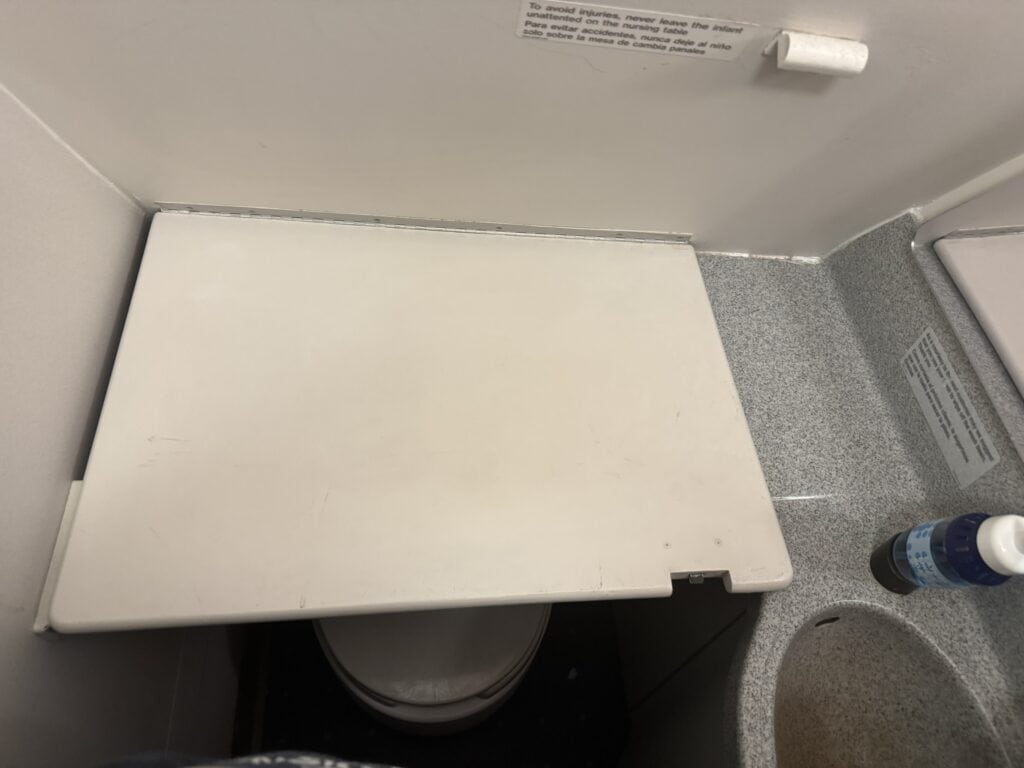
Yes, many airplane bathrooms have a fold-down changing table, usually above the toilet or along the wall. Not every lavatory on every plane will have one, so if you need it, ask a flight attendant which bathroom has the changing table before you start walking back with the baby.
Airplane changing tables are small, so I would not bring your entire diaper bag into the bathroom if you can avoid it. I usually prefer to bring only what I need:
- diaper
- wipes
- small changing pad
- diaper disposal bag
- hand sanitizer
- backup outfit if things are already looking risky
If you can change the baby before boarding, that is usually easier. But if you need to do it in the air, it is doable. It is just tight.
Should You Leave Kids in Their Seats While You Use the Bathroom?
This depends on your kids’ ages, personalities, the flight, and your comfort level.
When my kids were babies and young toddlers, I brought them with me. They were too little for me to feel comfortable leaving them in the seat alone, especially when I was the only adult traveling with them.
Now that they are older and much more seasoned flyers, I usually do leave both of them in their seats while I use the bathroom. They know what to expect on a plane, they understand that I’m coming right back, and I can usually keep the bathroom trip quick.
That would not have worked for us in the earlier stages.
Some kids will sit calmly and wait. Some kids will absolutely not. A baby secured in a car seat may not be going anywhere, but you may still feel uncomfortable walking away without another adult nearby. A toddler who loves unbuckling seatbelts or climbing over armrests is a very different situation from an older child watching a movie with headphones on.
This is one of those decisions where you have to know your own kids and the setup around you.
If you are nervous, you can always ask a flight attendant for help. They may not be able to hold a child or watch your kids every time, depending on what else is happening on the flight, but it is okay to ask. Sometimes they may be able to hold a baby for a minute, help you figure out which lavatory is easiest to use, or simply keep an eye on your row while you go quickly.
Once, a flight attendant told me only 2 people could be in the lavatory at once. I explained that I was the only adult traveling with 2 little kids, and he kindly offered to hold my youngest while I took the older one in.
That will not happen every time, but it was such a helpful reminder that you do not have to silently panic through every awkward airplane bathroom situation. Ask politely, explain what you need, and make the safest decision you can with the flight, your kids, and the moment you are in.
Public Bathrooms Abroad With Kids


Bathrooms abroad can be completely fine, or they can catch you very off guard.
I do not think it is helpful to list every country and exactly what bathrooms are like there, because even within one country, bathroom setups can vary a lot. A museum bathroom in a major city may be spotless and modern, while a train station bathroom down the road may be a totally different experience.
Instead, I think it helps to know what kinds of differences you might run into.
When traveling internationally with kids, you may find:
- paid public restrooms
- attendants who hand out toilet paper
- toilet paper located outside the stall
- no toilet paper at all
- no toilet seats
- squat toilets
- unfamiliar flush buttons, pull strings, or foot pedals
- bidets or handheld sprayers
- shared handwashing areas
- bathrooms that are not stroller-friendly
- places where you should not flush toilet paper
- bathrooms that are clean but very different from what your kids are used to
None of this means you should avoid international travel with kids. It just means you want to be prepared.
I now try to carry tissues or travel toilet paper, wipes, hand sanitizer, and small change in local currency. I also try to use bathrooms in places that are more likely to be reliable, like hotels, museums, restaurants, visitor centers, and larger attractions.
What We’ve Experienced Abroad
In Mexico City, bathrooms were more difficult for us than I had hoped. At Chapultepec Park, the restrooms we found were coin operated, and I did not have any cash with me. We ended up cutting that outing short and going back to the hotel.
Then, at the airport, we found a large accessible restroom near our gate, but the toilet did not have a seat. My daughter relied on her frog potty seat at the time, and without a standard toilet seat, it did not fit. She refused to go and ended up waiting until we were on the plane.
In Montreal, bathroom access felt a lot more like the U.S. We found clean, free restrooms at attractions and restaurants, though not all of them were stroller-friendly.
In London, we often used our hotel bathroom before heading out and planned around larger attractions like museums. Some restrooms were free and clean, but not always accessible with a stroller. At Victoria Coach Station, I had luggage, a stroller, and both kids with me, and I had to ask a worker to let us use an accessible stall because I did not feel comfortable leaving everything unattended.
In Bruges, we used a paid public restroom near the Belfort bell tower that had an attendant. It cost €1, and I had to leave the stroller outside, but the bathroom itself was clean and worked fine.
In Hamburg, the bathroom at Miniatur Wunderland was basically the dream. It was free, clean, and accessible, and I could roll the stroller right in.
Portugal was much easier for bathrooms than I expected. Across our trip, bathrooms were generally abundant and clean, especially in restaurants, cafés, attractions, and train stations. The only thing I had to keep in mind was that they were often coin operated or tied to making a purchase at a café or restaurant.
The point is not that one destination has “good” bathrooms and another has “bad” bathrooms. The point is that the setup can vary a lot, and when you’re traveling with kids, those little differences matter.
US Road Trip Bathrooms With Kids
Road trip bathrooms are their own category of family travel logistics.
Since we live in New York, many of our road trips involve driving across our home state. I have a whole new appreciation for the New York State Thruway now, because the rest stops are generally easy, clean, and predictable. They also usually have food options and playgrounds. That kind of setup matters so much more when you’re traveling with kids than it ever did before.
Outside of that, I try to be more intentional about where we stop. I usually avoid waiting until we are in a low-population area with limited options. If I know we’ll need a bathroom soon, I start looking earlier and aim for places that tend to have more reliable facilities.
For us, that often means familiar restaurants like McDonald’s or Starbucks, or gas stations and travel centers that usually have better restroom setups, like Sheetz, Wawa, or Buc-ee’s.
I also keep a small portable potty in the car with disposable bags. We do not use it often, but it gives me peace of mind on longer drives. If one of my kids suddenly has to go and there is no good bathroom nearby, we can pull over somewhere safe and handle it without turning the whole thing into a crisis.
For road trips, my bathroom strategy is basically:
- Start looking before it becomes urgent.
- Use reliable stops when you see them.
- Keep backup supplies in the car.
- Have a portable potty option for emergencies.
- Do not assume the next exit will have a bathroom that works for your family.
It is not glamorous, but it makes road trips feel a lot more manageable.
How I Find Bathrooms While Traveling
I do not rely on one method for finding bathrooms while traveling. I usually use a mix of Google Maps, common sense, and looking for places that are more likely to have decent facilities.
On Google Maps, you can often just type in “bathroom” or “public restroom” and see restroom icons pop up nearby. This does not work perfectly everywhere, but it can be really helpful in cities. I have a screenshot from London where Google Maps shows public restroom symbols right on the map, which is exactly the kind of thing I look for when we are out exploring and I want to know what options are nearby.


In cities, I also think about places that are more likely to have bathrooms available. Museums, department stores, hotels, libraries, larger restaurants, visitor centers, train stations, and family attractions are usually better places to start than hoping you randomly pass a public restroom right when your child needs one.
There are also apps, like Apps like Flush Toilet Finder & Map, that are made specifically to help you find public bathrooms around the world. I would not rely on any bathroom app completely, but it can be another helpful tool when you are somewhere unfamiliar.
When we were in Bruges, there were also signs with QR codes you could scan to open a map of public restrooms in the area. That kind of thing is easy to miss if you are not looking for it, but once you know bathroom maps exist, you start noticing them more.
When traveling internationally, it also helps to know the local word for bathroom or toilet. Even if you do not speak the language, being able to recognize words like “toilet,” “WC,” or the local equivalent can make a stressful moment a little easier.
Potty Training and Travel Bathrooms
Potty training and travel can be a tricky mix.
A child who is doing great at home may suddenly refuse to use an airplane bathroom, a public toilet without a seat, an automatic flush toilet, or a bathroom that looks or smells different than what they are used to.
That is normal.
If your child is newly potty trained, I would build in more backup than you think you need. That might mean pull-ups for travel days, extra underwear, extra clothes, wipes, and a portable potty seat if your child relies on one.
I also think it helps to practice public bathrooms before a trip. Not in a high-pressure way, but just enough that your child has experienced different bathrooms, louder flushes, hand dryers, and stalls before you are relying on them in an airport or another country.
A few things that help:
- Have kids try whenever you see a good bathroom.
- Carry a portable potty seat if your child needs one.
- Use pull-ups on long travel days if that reduces stress.
- Pack a full change of clothes in your carry-on or day bag.
- Bring bags for wet or soiled clothes.
- Talk about different bathroom setups before the trip.
- Expect a few weird moments.
And if an accident happens, it happens.
One of my kids once refused to pee in the airport or on the airplane, then had a full accident in the car seat of our private transfer from Orlando Airport to Disney World. I told the driver, offered to pay for cleaning, changed my son into the dry clothes I had packed, and we moved on.
That is not the kind of travel memory anyone dreams about, but it is also not the end of the world.
What I Pack for Bathroom Emergencies
I do not bring a massive bathroom kit everywhere we go, but I do like having a few things that make bathroom surprises easier to handle.
For travel days, I usually think about packing:
- wipes
- hand sanitizer
- tissues or travel toilet paper
- pull-ups or backup underwear
- a change of clothes for each kid
- Ziploc bags or wet bags
- a portable potty seat, if your child needs one
- a small changing pad
- diaper disposal bags
- sanitizing wipes
- small change or local coins when traveling abroad
For road trips, I may also keep a small portable potty in the car with disposable bags.
You may not need all of this for every trip. A baby, potty-training toddler, preschooler, and older child all have different bathroom needs. But I would rather carry a small backup plan than be stuck with no wipes, no toilet paper, and a child who suddenly needs help right now.
Bathroom Tips by Age
Different ages come with different bathroom challenges.
Babies
With babies, the biggest questions are usually diaper changes and changing tables. I try to change babies before boarding flights, before long drives, and before leaving places with good bathrooms.
I also like having a small changing setup that I can pull out quickly instead of bringing the entire diaper bag into a tiny bathroom.
Toddlers and Potty-Training Kids
This is probably the hardest bathroom stage for travel.
Toddlers may need to go urgently, refuse unfamiliar toilets, be scared of loud flushes, or need more physical help than a tiny airplane lavatory can comfortably allow.
This is the stage where I would be most likely to use pull-ups for travel days, bring a portable potty seat, and stop whenever we find a decent bathroom.
Preschoolers and Early Elementary Kids
This stage can be easier, but not always.
Kids may be more independent, but they may still need help with clothing, wiping, handwashing, or feeling comfortable in unfamiliar bathrooms. They may also be old enough to want privacy but not old enough to go fully alone in a crowded public place.
This is where it helps to talk through the plan ahead of time. Will they go with you? Will you wait right outside the door? What should they do if they need help?
Older Kids
Older kids may not need physical help, but they may still need support navigating unfamiliar public bathrooms, especially abroad or in busy places. I would still point out where bathrooms are, agree on a plan, and remind them not to wander off looking for one without telling you.
Bathrooms While Traveling With Kids Are Manageable
Bathrooms while traveling with kids are not glamorous, but they are manageable.
You do not need every bathroom to be perfect. You also do not need to know exactly what every restroom will look like before you go. A little preparation just helps you stay calmer when the setup is not what your family is used to.
Use good bathrooms when you see them. Carry the backup supplies your child might need. Think through the trickier moments ahead of time, like airports, airplanes, road trips, potty training, and unfamiliar public restrooms.
And if the bathroom situation gets awkward, that does not mean you did anything wrong. Sometimes your family may need more space, more time, or a little more help than someone traveling without kids. That is part of traveling with kids.
Take a breath, solve the next problem, and keep going.
If airport bathrooms, airplane lavatories, TSA, strollers, snacks, boarding, and all the little travel-day logistics feel like the part you’re most worried about, my Airport Survival Guide for Families walks through the airport process step by step so you can build a plan that works for your family.
Airport Survival Guide for Families
Flying with kids? This guide walks you through the airport step by step, from packing and parking to security, boarding, baggage claim, and beyond.
Airport Survival Guide for Families helps you think through strollers, car seats, bags, TSA, bathrooms, snacks, gate-checking, delays, and all the little logistics that can make airport days feel like a lot.
It’s based on real family travel experience, including many flights where I was the only adult with my kids, and it’s written to help the airport part of your trip feel more manageable.
Have questions about this post or want help thinking through the logistics for your own trip? Join my free Facebook community for parents planning family travel. You can ask questions, share what you’re working through, and get real-life advice from other parents who understand how many little details go into traveling with kids.