

Flying Alone With Kids: My Step-by-Step Airport Process

The first time I flew alone with my kids, my daughter was 9 months old and my son had just turned two.
At the time, I had never even flown with kids before, let alone done it by myself. And honestly, most of what overwhelmed me had nothing to do with the actual flight itself. It was the airport and trying to picture how all the logistics would physically work once we got there.
How was I supposed to push a stroller and luggage at the same time?
What exactly happens to the stroller at TSA?
How does gate check actually work?
What happens if my toddler suddenly needs the bathroom while we’re halfway through the airport with all our bags?
When you’re the only adult traveling with kids, there’s nobody to hand things off to. Nobody to hold the baby while you fold the stroller. Nobody to stay with the luggage or corral the toddler while you change the baby’s diaper in the bathroom. Even small airport tasks suddenly feel much more complicated because you’re responsible for every person and every bag at the same time.
Over the years, though, airports have gotten much easier for us. Not because my kids became perfect travelers, and not because I suddenly turned into some ultra-relaxed airport person, but because I slowly built an airport process that works for our family.
And that’s really what changed everything for me.
Once I stopped thinking about the airport as this giant overwhelming unknown and started treating it more like a series of smaller routines and decisions, it all became so much more manageable. We figured out what worked for us, what didn’t, and how to move through travel days with a lot less stress.
That doesn’t mean every trip goes perfectly. We still have delays, wrong turns, bathroom emergencies, forgotten water bottles, and occasional meltdowns. But airports don’t feel nearly as intimidating to me anymore because now I have systems for the parts that used to overwhelm me most.
This is the airport process I’ve developed over years of flying alone with my kids. Not because it’s the one “right” way to do things, but because sometimes seeing how another parent actually handles it all can make the whole experience feel a lot less overwhelming.
Before We Leave Home
I think one of the biggest things that helps our airport days feel less stressful is that I try to make as many decisions as possible before we even leave the house.
Because once we’re actually at the airport, there’s already so much happening. We’re navigating crowds, security lines, bathrooms, boarding times, snacks, tired kids, and constantly shifting logistics. The fewer decisions I have to make in the moment, the calmer the whole day usually feels.
Over time, I’ve realized that our airport setup matters just as much as what we pack.
I pack much lighter than a lot of families, mostly because physically moving everything through the airport by myself gets exhausting really quickly if we overpack. Most of the time, we travel carry-on only, so our setup is usually:
- one roller carry-on suitcase
- one backpack
- one stroller
- one travel document wallet
The suitcase holds our clothes and toiletries. The backpack is for the things we’ll actually need throughout the airport and flight, like snacks, water bottles, iPads, chargers, sticker books, medications, and anything I might suddenly need access to mid-travel day.
I also keep all of our important documents together in one travel wallet so I’m not digging through random bags trying to find passports or boarding passes while standing in line at airport security with people waiting behind me.
And honestly? The actual gear setup itself makes a much bigger difference than I originally realized.
On one of my first trips alone with the kids, I used an old roller suitcase we already had at home because I figured luggage was luggage and it seemed silly to buy another one. One of the wheels was partially broken, though, and instead of rolling smoothly beside the stroller, the bag dragged awkwardly behind me the entire trip.
By the end of that travel day, after dragging it through the Fort Lauderdale airport and then all through the cruise terminal afterward, I was completely miserable.
That was one of the moments that really made me realize that when you’re flying alone with kids, your setup needs to work with you, not against you.
Now I use a roller bag that moves easily beside the stroller, and our stroller has a single push bar so I can steer it one-handed if needed. It also folds one-handed, which matters a lot when you’re holding a tired child and trying to collapse a stroller at the gate.
None of these things sound huge individually, but together they completely changed how manageable airport days feel for me.
The kids are very used to airports now, but before their first flights, we also spent a lot of time reading books and watching shows about airports and airplanes so the experience would feel more familiar once we got there.


Calm at the Gate: An Airport Survival Guide for Solo Parents
Traveling alone with kids? This guide gives you the exact steps, tools, and mindset shifts that make flying solo less overwhelming—from check-in to baggage claim.
Calm at the Gate: An Airport Survival Guide for Solo Parents walks you through airport logistics, answers the questions you didn’t know to ask, and helps you feel more confident (and less flustered) at every stage of the journey.
Whether you’re gearing up for your very first solo trip or still figuring out how to make airport travel feel less chaotic, this guide will help you move through it all with fewer surprises, fewer meltdowns, and a lot more calm.
Getting to the Airport
One thing I’ve realized over the years is that the smoother I can make transitions, the smoother the entire airport day usually feels.
That’s one of the main reasons I almost always park in the airport garage now.
I know garage parking is more expensive, but for me, the convenience is absolutely worth it when I’m flying alone with kids. Since I rely heavily on the stroller to move both kids and bags through the airport, avoiding shuttle buses removes an entire layer of stress from the day.
Otherwise, getting to the terminal suddenly becomes its own complicated process. I’d have to unload the kids, fold the stroller, manage luggage separately, get everyone onto the shuttle, and then set everything back up again once we arrived at the airport.
Sometimes eliminating even one extra transition can make a huge difference.
Parking in the garage also helps a lot during winter travel here in Western New York. If we’re flying somewhere warm, I can usually leave our winter coats in the car instead of dragging bulky coats through the airport for the rest of the trip.
I also learned another airport parking lesson the hard way after a late-night flight home when I completely forgot where I parked and wandered through the parking lot for twenty minutes with exhausted kids trying to find the car.
Now I always take a picture of the parking section before we walk into the terminal. It’s one of those tiny things that takes five seconds but saves so much stress later.
Most of the time, my kids stay in the stroller all the way through airport security. That containment piece alone made flying with young kids feel dramatically more manageable for me, especially when they were younger.
Now that my son is getting older, I let him walk more often in calmer situations or smaller airports, and recently he and I even did a solo trip without the stroller entirely. But when my kids were littler, having everyone contained in one place made airport travel feel easier both physically and mentally.
And honestly, that’s become a big part of my overall airport process now: figuring out which small decisions reduce friction before the stressful parts even happen.
Check-In and Baggage Drop

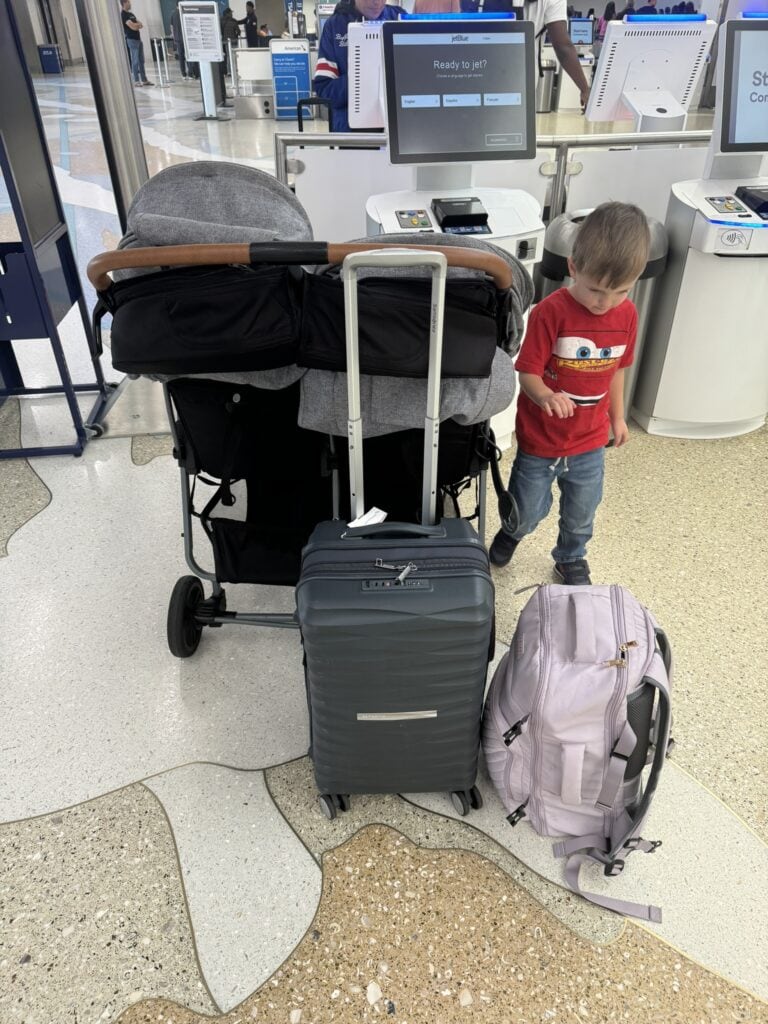
Most of the time, we actually skip the airport check-in counter completely.
I check us in online ahead of time, and since we usually travel carry-on only, we can head straight toward TSA once we arrive at the airport.
That’s become a big part of our normal airport process because I eventually realized that baggage claim was one of the most exhausting parts of travel for me when I was alone with the kids.
After a long travel day, everybody is usually tired, overstimulated, hungry, and ready to leave. Standing around baggage claim waiting for suitcases to appear can feel much harder at the end of the travel day than it sounds on paper.
One time we waited over an hour for bags in Orlando after a flight, and by that point everyone was completely done with the airport experience.
Since then, I’ve personally preferred keeping our luggage with us whenever possible.
That said, I definitely don’t think carry-on only is automatically the right choice for every family. There are absolutely benefits to checking bags too, especially if traveling lighter would create more stress instead of less.
For us, though, having fewer things to physically manage through the airport usually makes the day feel much easier overall.
I also think this is one of the parts of flying with kids that feels more intimidating before you actually do it.
A lot of parents aren’t fully sure:
- whether they need to stop at the check-in counter
- where to go if they already checked in online
- how baggage drop works
- or which line they’re even supposed to be standing in
And honestly, I remember feeling the same way before our first trip.
But once you go through the process a couple of times, airports start feeling much less mysterious. You begin realizing that most of the systems are actually pretty repetitive, even if they feel overwhelming at first.
Getting Through TSA With Kids
TSA used to be the part of airport travel I dreaded most, mostly because I constantly felt rushed and worried that we were holding everyone up.
Now I mostly just remind myself that we deserve to take up space there too.
If the people behind us are impatient, that’s okay. If something takes an extra minute, that’s okay too. We’re allowed to move through airport security at the pace that works for our family.
We have TSA PreCheck now, so we usually use that line. Before we had it, I would look for family security lanes whenever airports offered them because they often felt a little calmer and less chaotic with kids.
At this point, our process through TSA is actually pretty simple.
I try to have our boarding passes and IDs easily accessible before we even reach the front of the line, and the kids stay in the stroller until the last possible second because containment makes everything easier for me during busy transitions.
Once we reach the conveyor belt, I load the bags on the belt, take the kids out of the stroller, and TSA agents usually pull the stroller aside separately for inspection while we walk through the scanner together.
When my kids were babies, TSA agents almost always let me carry them through the scanner instead of requiring them to walk independently through the scanner area.
Sometimes our bags still get pulled for additional screening, probably more often than I’d prefer. But at this point, I don’t really panic about it anymore because it happens constantly when you’re traveling with snacks, kids’ gear, electronics, water bottles, and all the random things families carry.
One time I tried bringing caramel apples home from Disney World through Orlando security and learned very quickly that TSA apparently considers caramel apples suspicious enough to inspect more closely. They did let me keep them.
Things like that used to completely stress me out. Now it mostly just feels like part of travel.
I think that’s one of the biggest mindset shifts that’s happened for me over the years. TSA stopped feeling like this huge intimidating mystery once I understood the general flow of how airport security actually works with kids.
And honestly, having a repeatable process for security is one of the things that has helped our travel days feel dramatically less stressful overall.
If TSA is the part of flying with toddlers that feels most overwhelming to you, this is actually something I walk through in much more detail inside my Airport Survival Guide, including the exact systems and preparation steps that help our security days go more smoothly.
Calm at the Gate: An Airport Survival Guide for Solo Parents
Traveling alone with kids? This guide gives you the exact steps, tools, and mindset shifts that make flying solo less overwhelming—from check-in to baggage claim.
Calm at the Gate: An Airport Survival Guide for Solo Parents walks you through airport logistics, answers the questions you didn’t know to ask, and helps you feel more confident (and less flustered) at every stage of the journey.
Whether you’re gearing up for your very first solo trip or still figuring out how to make airport travel feel less chaotic, this guide will help you move through it all with fewer surprises, fewer meltdowns, and a lot more calm.
Navigating the Terminal
This is the part of the airport experience that changes the most depending on where we’re flying.
My home airport in Rochester, NY is tiny, quiet, and very easy to navigate. Then you get to airports like JFK, Atlanta, or Orlando where there are multiple terminals, huge crowds, gate changes, trains, escalators, and people rushing around everywhere.
International airports can feel completely different too, especially when everything is in another language or the procedures work differently than what you’re used to.
Usually once we get through airport security, the first thing I do is check the departure boards and make sure I fully understand where our gate is located.
And honestly, when airports feel overwhelming to me, the biggest thing I try to remember is that I only need to figure out one step at a time. I do not need to mentally solve the entire airport all at once. I just need to figure out where we’re going next.
If I’m unfamiliar with the airport, I’ll sometimes walk to the gate first before we stop anywhere else, just so I know exactly where we’re going and how long it takes to get there. I’ve found that once I understand the layout of the terminal, the entire airport immediately starts feeling less stressful.
After that, we usually look for food.
Over the years, I’ve realized that meals and snacks are one of the easiest ways to break up airport time with kids. Sitting down to eat gives everybody a chance to reset a little before boarding starts.
If the airport has a lounge, we’ll often use that too since we have Priority Pass access through one of our credit cards. Having a quieter place to sit, charge devices, eat snacks, refill water bottles, and regroup can make a huge difference during long travel days, especially in crowded airports.
After food, I usually try to find somewhere the kids can move around before boarding.
Sometimes that’s an airport playground if the terminal has one. Other times it’s just a quieter section of the airport where they can walk around and get some energy out before sitting on the airplane.
I try really hard not to keep them sitting at the gate too long before boarding starts because once we’re on the plane, they’ll already be expected to sit much longer than they want to.
Before boarding, we always do one final bathroom stop, refill water bottles if needed, and then I head to the gate counter to get a gate check tag for the stroller.
At this point, that whole rhythm has become part of our normal airport routine too. And honestly, I think having those familiar routines is one of the things that makes flying with kids feel so much less overwhelming now than it did in the beginning.
Boarding the Plane
When my kids were younger, boarding honestly felt like the hardest physical part of the entire airport process.
I would keep them in the stroller all the way down the jet bridge because I needed the containment, and because it was much easier than trying to manage tired toddlers, bags, boarding passes, and a folded stroller all at the same time.
Then right at the airplane door, I’d have to quickly unload the kids, fold the stroller, grab the bags, and somehow get everybody onto the aircraft all at once.
Now that my kids are older, boarding feels dramatically easier because they can walk independently down the jet bridge themselves.
I still usually avoid boarding too early, though. Unless we specifically need extra time, I prefer letting the kids move around as long as possible before getting on the plane.
At this point, successful boarding honestly just means getting everybody onto the aircraft relatively calm and with all our belongings still accounted for. That’s the only goal.
One thing airport travel has taught me over the years is that backup plans make everything feel less stressful mentally.
A few years ago, we were flying from Orlando to Mexico City with a connection in Miami, after a few days in Disney World. Our first flight kept getting delayed, and by the time we finally landed, we were extremely close to missing the second flight.
We were also sitting in the very back row of the airplane.
As we were taxiing to the gate, I had already decided in my head that if we missed the connection, I was probably going to rent a car and drive back to Disney World instead of continuing to Mexico City for only one night.
Having already made that decision made me feel calmer. I think that’s something I’ve learned over the years with flying alone with kids: sometimes having a backup plan matters just as much as the actual plan itself.
The second we got off the plane, I loaded the kids into the stroller and ran through the Miami airport as fast as I possibly could.
They were literally closing the boarding door when they saw us coming and held it open for us. We made it. And honestly, that experience reminded me of something I think about a lot now when we travel:
Even when airport days go sideways, you usually figure it out.
That doesn’t mean it’s always easy. Sometimes it’s exhausting and stressful and messy. But airports stopped feeling nearly as intimidating once I realized that most travel problems are survivable, even when they don’t go according to plan.
What Has Actually Helped Me Most
At this point, I don’t think airport travel feels easier because I’ve somehow mastered it. It feels easier because we know our rhythm now.
Over time, I’ve learned which parts of the airport tend to overwhelm us, where transitions usually get chaotic, what helps my kids regulate before a flight, and what tends to make the day harder for everybody.
And honestly, I think that familiarity changed things more than anything else.
The airport feels a lot less intimidating now because I’m no longer trying to figure everything out in real time every single trip. We already have a general flow that works well for our family, and that alone removes a huge amount of stress from travel days.
That definitely does not mean every trip goes perfectly.
Flights still get delayed. Kids still melt down sometimes. Somebody always seems to suddenly need the bathroom at the worst possible moment. But having systems in place makes those situations feel much more manageable because I’m not making every decision from scratch while already overwhelmed.
Over the years, I’ve realized that flexibility matters a lot more than perfection when you’re flying alone with kids.
And if you’re getting ready for your first flight alone with your kids, you do not need to have every detail perfectly figured out ahead of time. You also do not need to copy exactly what another family does.
You just need a process that works for your family and enough flexibility to adjust when travel days inevitably don’t go perfectly.
This post is honestly just a small glimpse into the airport routines and systems I’ve built over years of traveling alone with my kids.
This is obviously just the airport process that works best for our family, and every parent eventually figures out their own rhythm with travel.
But if you want a much deeper walkthrough of the entire airport process itself, including the logistical and emotional realities of traveling alone with kids from curb to baggage claim, my full guide breaks down every stage of the airport experience step by step so you can figure out what works best for your family.
It includes detailed airport walkthroughs, planning systems, checklists, backup plans, and the tools I personally use inside Calm at the Gate: An Airport Survival Guide for Solo Parents.
Have questions about these tips or want advice from other solo parents? Join my free Facebook community for parents traveling alone with babies, toddlers, and young kids. You’ll find support, real-life answers, and tips from parents who’ve been there, wherever you’re headed in the world.
More Tips for Flying With Kids
- 8 Ways to Survive an Overnight Flight Alone With Toddlers
- Child Travel Consent Letter: Do You Need Permission to Travel With Your Child?
- How to Go to the Bathroom When Traveling Alone With Toddlers
- Flying With a Lap Infant: What to Know Before You Go (From a Parent Who’s Done It Solo)
- How to Get Through TSA With a Toddler (Step-by-Step Guide for Parents Flying Solo)