
Best Type of Compression Packing for Carry-On Only Travel With Kids

If you’ve followed me for any amount of time, you know one of my biggest tips for traveling with kids is to pack light.
When you’re pushing a stroller, keeping track of kids, and moving through an airport with bags, you just don’t have extra hands for unnecessary luggage. The lighter we pack, the smoother everything goes.
When I travel with my kids, we usually bring one carry-on spinner suitcase, one backpack, and our double stroller. That’s it. No checked bags. No extras.
That system started because I often travel as the only adult with my kids, but it has worked beautifully for our family in general.
But then we spent a week in Disney World during that weird in-between season where the mornings are cold enough for sweatshirts and jackets and the afternoons are hot enough for t-shirts and shorts. That meant packing sweatshirts, light jackets, and extra layers we wouldn’t normally bring, and those pieces take up real space in a carry-on.
For the first time, I started wondering if I was reaching the limit of what I could realistically fit into one suitcase for three people.
So I decided to experiment.
For this trip, I tried five different packing setups: no packing cubes at all, regular packing cubes, double-zip compression packing cubes, roll-up compression bags, and portable vacuum compression bags.
After testing all five, one clearly worked better than the rest for our family.
The double-zip compression packing cubes were the only option that gave us extra space without creating new problems.
Below, I’ll share what worked and what didn’t with each one so you can decide what makes the most sense for your own family.
Quick Comparison of Compression Packing Types
Before I get into the details of each setup, here’s a quick side-by-side look at how they compared once everything was packed into the suitcase. If you’re just looking for the short version, this will give you the big picture.
| Type | Did It Save Space? | Was It Easy to Use? | Did It Fit Well in a Carry-On? | My Overall Take |
|---|---|---|---|---|
| No Packing Cubes | No | Very easy | Yes | Worked fine for years |
| Regular Packing Cubes | Not really | Very easy | Yes | Great for organization |
| Double-Zip Compression Cubes | Yes, noticeably | Moderate effort | Yes | Best overall |
| Roll-Up Compression Bags | In theory | Hard | Not really | Frustrating |
| Portable Vacuum Bags | In theory | Moderate effort | Not really | Impractical for carry-on |
If you’d rather see everything side by side, I filmed a quick video showing each setup in the same suitcase so you can see the difference visually.
Now here’s how each one actually performed when I packed for Disney.
Traveling with kids?
Get the Free Travel Documents Checklist for Families
Before you head to the airport, make sure you’ve thought through the documents your family may need, including IDs, passports, birth certificates, consent letters, health documents, and helpful backup copies.


The Real-Life Test: How Each Packing Setup Performed


For this trip, I packed the same general mix of clothes using each method so I could see how they actually compared. Same suitcase. Same weather layers. Same three people sharing one carry-on.
Here’s how each setup performed once everything was zipped up and ready to go.
No Packing Cubes at All


For years, this was my method. I thought packing cubes were a gimmick, so I just packed everything loose. The suitcase itself compresses clothing, and if it looked too full, I’d sit on it and zip it closed.
And honestly, that works. You can absolutely travel carry-on only without any kind of compression packing. I did it for years without a problem.
The downside doesn’t really show up until you arrive.
When everyone’s clothes are loose in one suitcase, you end up digging through mixed piles trying to find one child’s pajamas or your own sweatshirt. It works, but it’s not efficient.
In terms of space savings, this method relies entirely on the suitcase doing the compressing. You can squeeze things down, but you don’t really gain extra room. You’re just forcing it closed.
For short trips with lightweight clothing, this is completely fine. But for a week at Disney with variable weather, it started to feel like I was pushing the limit.
Samsonite Octiv Lightweight Hardshell Carry-On
This isn’t the exact suitcase I use (mine was discontinued), but it’s the closest match in the same brand, size, and style. What I love about this one for carry-on only packing is the built-in interior compression panel with a second zipper that helps flatten everything down before you close it. Paired with compression packing cubes, that extra squeeze makes a noticeable difference when I’m fitting three people’s clothes into one suitcase. It rolls easily, fits in overhead bins, and has held up really well for us.
Regular Packing Cubes


A few months ago, a friend gave me a set of packing cubes, so I decided to try them. I wasn’t expecting much. I mostly just wanted to see if they made any real difference.
Space-wise, they didn’t change much. The cubes still had some puff to them. Once inside the suitcase, they popped up the same way loose clothes do. I could still sit on the suitcase and zip it closed just like before.
But for organization, they were a total game changer. Instead of digging through a pile of everyone’s clothes at the hotel, I could pack one cube per person. When we arrived, unpacking was simple. I put each child’s cube straight into their drawer and didn’t have to dig through anything at all.
That’s what sold me.
They didn’t make the suitcase any roomier, but they made living out of it a lot less chaotic.
Veken Packing Cubes Set
These are the regular packing cubes I tried after a friend passed along a set to me. They’re made from durable polyester with smooth two-way zippers and breathable mesh panels so you can easily see what’s inside. The set includes multiple sizes, plus a toiletry bag and laundry bag, which makes organizing everything in your suitcase simple. If your main goal is keeping clothes sorted and easy to access during your trip, this style works really well.
Double-Zip Compression Packing Cubes


This was the first setup that actually felt different.
Double-zip compression cubes are basically regular packing cubes with a second zipper around the outside. You pack them the same way, zip them closed, and then use that extra zipper to pull everything tighter and flatten it down before it ever goes into your suitcase.
For our Disney trip, that extra step ended up mattering more than I expected.
We were packing sweatshirts for chilly rope drop mornings, light jackets just in case, and regular park clothes for the afternoon heat. Add pajamas and backup outfits for two little kids, and it starts to add up quickly.
With regular packing cubes, everything technically fit, but it felt tight. The suitcase closed and I could make it work, but there wasn’t much room to spare.
When I packed the same clothing into the double-zip compression cubes, the difference wasn’t dramatic, but it was clear. Once everything was zipped down, the cubes sat flatter, and when I placed them in the suitcase they stacked more neatly instead of puffing up the way regular cubes do. The suitcase still closed easily, and it didn’t feel like I was forcing it.
They aren’t perfect. Zipping that second zipper takes effort. It’s not hard, but it does feel like you’re squeezing down three mini suitcases in a row.
But once they’re zipped, they stay that way. There’s no plastic to seal, no vacuum to rely on, and nothing fragile that might fail mid-trip.
For carry-on only travel with kids, that combination of extra space and reliability ended up being exactly what we needed.
BAGAIL Double-Zip Compression Packing Cubes
These are the exact double-zip compression cubes I used for this trip. I actually bought them after asking for recommendations in a travel Facebook group, and one person said they were obsessed with these and wouldn’t use anything else. They’re made from a sturdy fabric, have smooth double zippers, and include the second compression zipper that flattens everything down once the cube is packed. The half-mesh panel makes it easy to see what’s inside, and the different sizes made it simple to separate everyone’s clothes. For our carry-on only packing, this set gave us the extra squeeze we needed without feeling complicated.
Roll-Up Compression Bags

I really wanted these to win.
On paper, they sound like a great idea. You roll the air out, everything shrinks down, and you’re supposed to gain extra space.
In practice, I found them frustrating.
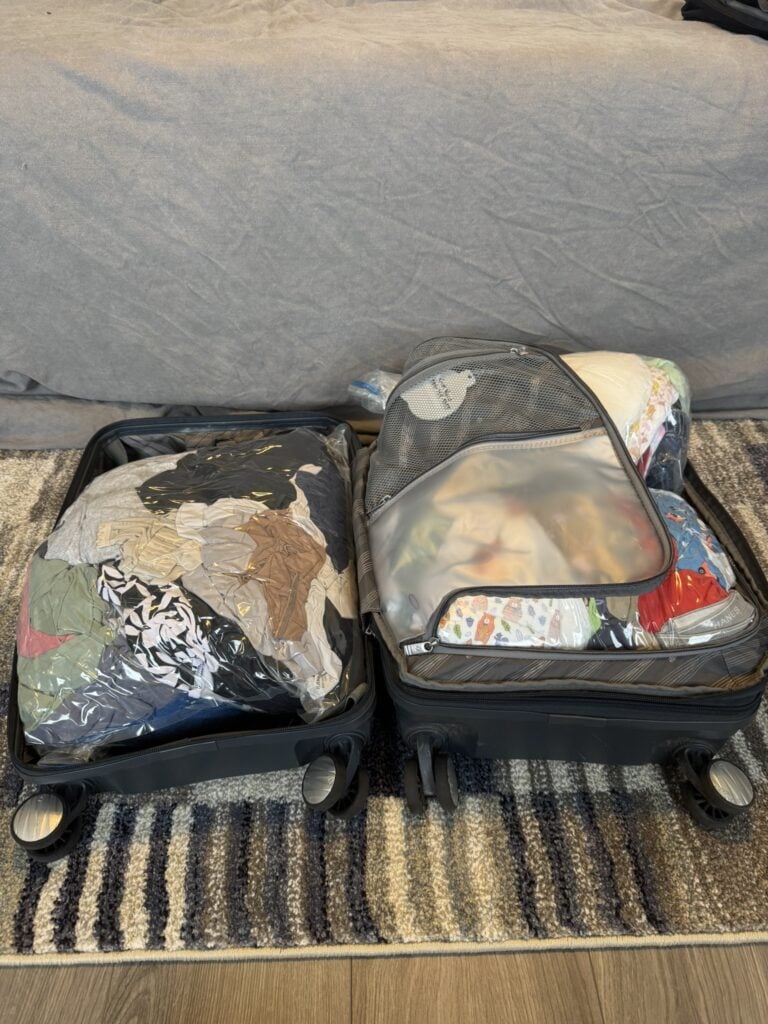
Getting the clothes into the bags neatly wasn’t easy, and rolling the air out took more effort than I expected. I had to sit on the bag to push the air out, and even then it never felt completely flat.
Once compressed, the shape was awkward. Instead of neat rectangular cubes, I was left with floppy plastic bundles that didn’t fit cleanly inside a structured carry-on.
They also depend entirely on an airtight seal. If that seal fails while you’re traveling, the whole system falls apart.
I can see them being useful for bulky winter coats or puffer jackets, but for regular family travel clothing, they just felt like more work than they were worth.
Cozy Essential Roll-Up Compression Bags
These are the roll-up compression bags I tested after someone in a travel Facebook group recommended them as their favorite. They don’t require a vacuum—you simply seal the bag and roll the air out by hand—and the set comes with multiple sizes for different types of clothing. The material is thick and reusable, and they’re designed to protect clothes from dirt and moisture while saving space. If you’re looking for a vacuum-free compression option that can be reused for travel or home storage, this is the style I tried.
Portable Vacuum Compression Bags


These were definitely easier than the roll-up version since the small travel vacuum removes the air for you.
But once everything was compressed, I ran into the same issues. The shape still didn’t fit neatly into a carry-on, and getting the clothes loaded evenly inside the bag felt awkward. They also depend on both plastic seals and a device working properly.
For carry-on only travel, that’s where I get hesitant. I don’t love relying on something that could malfunction, lose suction, or stop sealing halfway through a trip.
They do compress clothing significantly. There’s no question about that.
But for me, the added bulk of the bags, the shape inside the suitcase, and the dependence on extra equipment outweighed the benefit.
Rechargeable Wireless Travel Vacuum Compression Bags
This is the exact vacuum compression set I tested for this trip. I chose it after reading through Amazon reviews and liked that it came with multiple bag sizes and a small rechargeable pump that doesn’t need to be plugged into a wall. The pump charges with USB-C, is compact enough to toss in your suitcase, and the bags have a clear design so you can see what’s inside without opening them. If you’re looking for a travel-friendly vacuum option with a cordless pump, this is the style I used.
So, What Is the Best Type of Compression Packing for Carry-On Travel With Kids?
If you’re wondering what the best type of compression packing is for carry-on only travel with kids, my answer after testing all five setups is definitely double-zip compression packing cubes.
Do compression packing cubes work? Absolutely. But not all of them work the same way.
Regular cubes are great for organization but won’t create much extra space.
Roll-up and vacuum compression bags shrink clothing significantly, but they introduce new complications.
Double-zip compression cubes sit in the middle. They provide noticeable compression while still fitting neatly into a carry-on and staying easy to manage throughout your trip.
For our family, that balance made all the difference.
Have questions about this post or want help thinking through the logistics for your own trip? Join my free Facebook community for parents planning family travel. You can ask questions, share what you’re working through, and get real-life advice from other parents who understand how many little details go into traveling with kids.